System Architecture
End-to-end pipeline architecture from topic input to published paper.
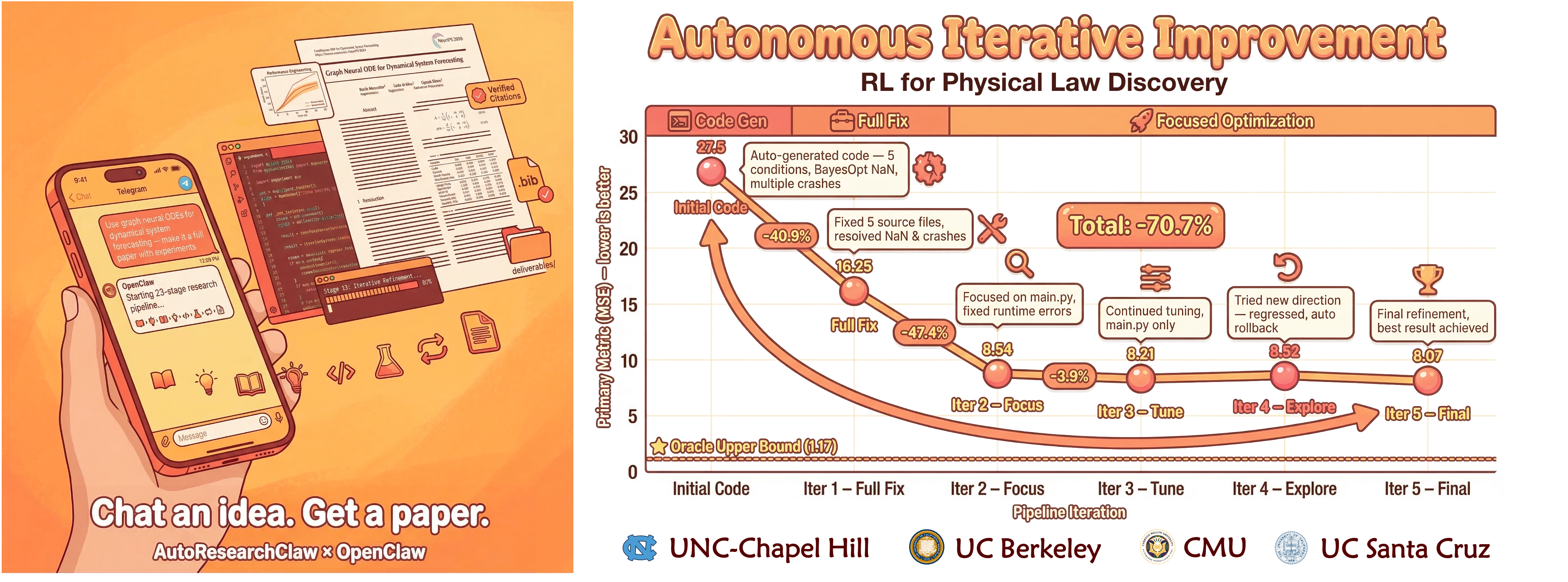
e5o is a fully autonomous 23-stage pipeline that transforms a research topic into a conference-ready paper — with real experiments, GPU-accelerated code, and verified citations.
Eight autonomous phases transform a research topic into a publication-ready manuscript.
Topic initialization, problem decomposition, and scope definition.
Multi-source paper search via OpenAlex, Semantic Scholar, and arXiv with quality screening.
Gap analysis, trend synthesis, and novel hypothesis generation.
Methodology design, code generation, and resource planning with hardware awareness.
GPU-accelerated Docker sandbox execution with iterative refinement.
Result analysis with pivot/refine/proceed decisions.
Structured drafting, multi-agent peer review, and iterative revision.
Quality gate, knowledge archival, LaTeX export, and citation verification.
Eleven AI agents, each with a job. As your paper is written they take turns — and at the hypothesis and analysis stages, the Innovator, Pragmatist, and Contrarian genuinely debate each other before anything is decided.
Frames your idea into a clear goal and steers the direction; decides whether to proceed, refine, or pivot.
Searches OpenAlex, Semantic Scholar, arXiv & Google Scholar, then screens and extracts the key findings.
Connects everything that's known into a clear picture of the gaps worth pursuing.
Pushes for bold, novel hypotheses and interpretations.
Keeps ideas feasible and grounded in what can actually be tested.
Attacks weak assumptions and guards against wishful thinking.
Designs the experiments, writes the code, and runs them for real.
Outlines, drafts, and revises the paper.
Critiques the draft like a journal referee.
A second independent referee, so the paper survives real scrutiny.
Checks every claim and citation and guards against fabricated results.
Cards marked Debate team argue with each other — the Innovator, Pragmatist, and Contrarian hash out every hypothesis, while Reviewers A & B independently tear into the draft.
Built for serious research, engineered for reliability.
Multi-source search across OpenAlex, Semantic Scholar, and arXiv with circuit breakers, rate limiting, and intelligent caching.
Experiments run in isolated Docker containers with NVIDIA GPU passthrough, network sandboxing, and automatic dependency management.
Simulated conference-style peer review with multiple reviewer personas providing structured feedback for revision.
Automatic pivot/refine/proceed decisions with rollback to any previous stage based on experiment outcomes.
Publication-quality LaTeX output with proper citations, experiment charts, and structured abstracts.
All citations verified against CrossRef, OpenAlex, and arXiv APIs to ensure bibliography accuracy.
Papers generated entirely by the pipeline, from topic to camera-ready PDF.
Investigates adaptive curriculum strategies on CIFAR-10/100 benchmarks, demonstrating improved convergence speed and final accuracy compared to standard training.
Explores test-time adaptation methods using batch normalization statistics to handle distribution shift on CIFAR-10-C corruption benchmarks.
Proposes entropy-guided intrinsic reward bonuses to improve exploration in sparse-reward MuJoCo locomotion environments.
End-to-end pipeline architecture from topic input to published paper.
Clone the repo, configure your LLM API key, and run your first autonomous research paper.